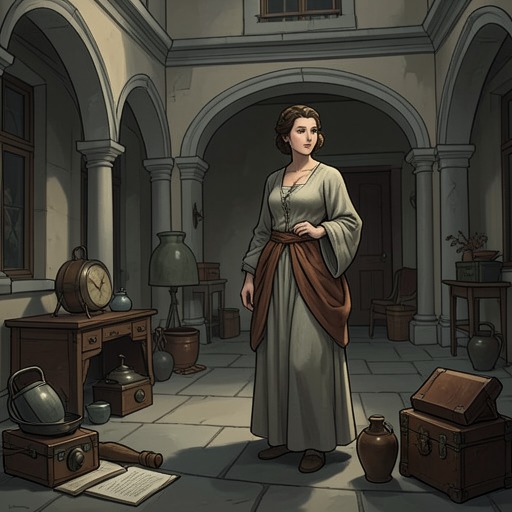
The narrator revisits the secret abortion location
Simple PassionThe narrator’s return to the site of a clandestine abortion twenty years earlier is an act of deliberate remembrance undertaken during grief over A. She hopes that revisiting the place might counterbalance the present, but finds no simple resolution: the journey alters nothing, while allowing her to reclaim an episode she had once lived through and to consider how private experience might become shareable through writing.
The Impulse to Return
The visit begins as an overriding urge to go to Passage Cardinet, in the 17th arrondissement, where the narrator had undergone a clandestine abortion two decades before. She feels it is imperative to see the street and building again and to go up to the flat where the events took place. Her hope is tentative: she vaguely imagines that confronting an earlier trauma might cancel her present grief, which is bound up with A.
The return is therefore not prompted by a claim that the past can be undone. It is an effort to bring two painful experiences into relation. The earlier event had also been caused by a man, and revisiting its location offers the narrator a way to acknowledge that history while she is consumed by a more recent loss.
Finding the Former Place
The narrator gets off at Malesherbes Metro station, in a square whose recently changed name means nothing to her, and has to ask a grocer for directions. The plaque marking Passage Cardinet has partly erased lettering. Its façades, by contrast, have been newly restored and painted white: the remembered location remains identifiable, but its visible surface has changed.
At the address she recalls, she pushes open one of the few remaining doors without a digital code and looks at the tenants’ list. The elderly woman who had lived there, an auxiliary nurse, has either died or moved to a retirement home in the suburbs. The people now living on the street belong to a high-income bracket. These details place the narrator’s memory against a changed building and neighborhood, where the people and conditions associated with the old episode have largely disappeared.
As she heads towards Pont-Cardinet, she remembers the old woman accompanying her to the nearest station. She understands the woman’s gesture as an effort to ensure that the narrator would not collapse outside her door. The recollection restores a small but consequential act of care to the scene: the past returns not only as the narrator’s own ordeal, but through the presence of someone who had seen her in a vulnerable state.
Memory, Reality, and Literature
Standing in the former setting, the narrator thinks that she was there one day and wonders what separates that past reality from literature. She suggests that the distinction may lie in disbelief: the sense that she herself actually occupied the place, a feeling she would not have had about a fictional character. The visit thus makes the gap between lived experience and written representation part of the memory itself.
This uncertainty does not make the episode less real; rather, it reveals how difficult it can be to recognize one’s own past as something that happened. The street’s altered appearance and the absent people intensify the distance, while the remembered journey back from the flat briefly brings the earlier event into the present. The narrator’s question turns a private recollection into a question about how experience can be told and believed.
What the Return Changes
After going back to Malesherbes station and taking the Metro, the narrator concludes that the episode has altered nothing. Her grief remains. Yet she is glad that she took the initiative and revived what she calls an act of despoilment, also caused by a man. The return matters not as a cure, but as an act she chose: it gives the narrator a way to revisit an experience that belongs to her own history without claiming that revisiting it can erase its consequences.
She asks whether she is the only woman to return to the scene of an abortion. The question opens onto the possible public purpose of writing: to find out whether others have done or felt the same things, and, if not, to help them regard such experiences as normal. She also imagines that readers might in turn live through similar emotions, perhaps forgetting that they encountered them in a book. The visit thus ends without a resolution of grief, but with an inquiry into recognition: how an experience first borne privately might be made legible to others.